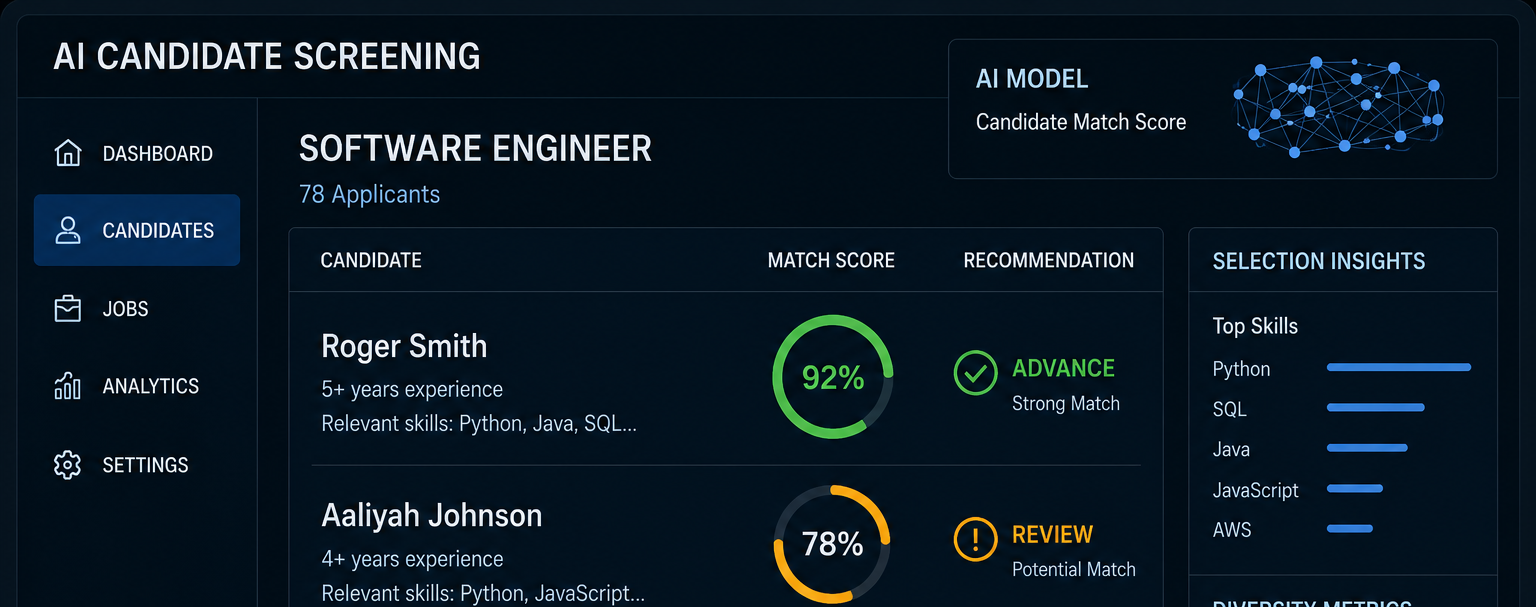
AI has become the centerpiece of innovation, showing up in conversations across nearly every industry because it seems FOMO is running rampant. Its promise to streamline operations and boost efficiency has businesses rushing to adopt it wherever they can, and recruitment is no exception. AI now plays a role in how many companies source, screen, and rank candidates before a human ever sees a resume. What gets less attention in that excitement is a harder question: What happens when the tool doing the screening carries the same blind spots as the people who built it? AI doesn’t invent bias out of nowhere. It’s trained on human generated data, which means whatever patterns already exist in that history get absorbed right along with everything else.
This has been documented for years. Back in 2018, Amazon scrapped an internal recruiting tool after discovering it had taught itself to penalize resumes containing the word “women’s,” things like “women’s chess club captain,” because it had trained on a decade of hiring data skewed heavily male in technical roles. Amazon caught it and killed the project, but the story stuck around as a cautionary tale about how bias creeps in without anyone deciding to put it there.
What’s changed since the early days is the scale and the legal consequences. Most large employers today run some form of AI across their screening process. States and courts are starting to weigh in on what that means for accountability. Recently, in Mobley v. Workday, a federal court in California allowed a nationwide collective action to move forward against Workday, whose platform scores and ranks applicants against job requirements. The court’s reasoning matters here: it ruled that Workday’s role in hiring doesn’t become less significant just because AI algorithms are doing the work instead of a person reading resumes by hand. Anti-discrimination law, the court said, doesn’t carve out a software exception. “The algorithm did it” isn’t a defense.
There’s also newer research on what happens once a human is back in the loop reviewing AI output. A 2025 University of Washington study found that recruiters using AI tools with biased scoring ended up mirroring those biased choices in the large majority of their own decisions. Whereas recruiters given unbiased AI, or no AI at all, made far more equitable picks. So the tool itself isn’t automatically the villain of this story, but badly built AI can make human bias worse.
At the end of the day, it’s not whether AI can be biased, it’s how much thought and care goes into building these systems and monitoring them after they’re live to ensure it isn’t. These AI models learn from huge piles of past hiring data, and if that data has bias baked in somewhere, the model picks it up too, whether anyone meant for that to happen or not. And it rarely announces itself. It just quietly shapes who gets seen and who gets filtered out, until one day you look back and realize the pattern’s been there for months.